Inside Army–Navy
Mascot Heists, March‑Ons, and the Greatest American Rivalry

On December 13th, hours before kickoff, M&T Bank Stadium won’t sound like any other college football venue.
What you hear is cadence: drums, shouted commands, and rows of polished military oxfords striking the turf (mostly) in unison as the Naval Academy’s Brigade of Midshipmen and West Point’s Corps of Cadets arrive in formation.


This is the March‑On. It happens before every Army–Navy game. And if you’re in the stadium, you realize something fast: This is way bigger than a football game.
135 Years of America’s Game
The Army-Navy game is a 135-year-old tradition that began in 1890. Navy had been playing organized football since 1879 and challenged Army to its first game. The Midshipmen won, 24-0, and the rivalry was born. Since then, Navy leads the series, 63-55-7.


But it hasn’t always been smooth sailing (or marching). From 1894-1898, the game was canceled after an Army general and a Navy admiral nearly dueled over a disagreement following the 1893 game. Yes, a DUEL. President Grover Cleveland had to step in. This rivalry gets intense. In 1899, the rivalry games resumed.1
Since 1930, the game has been an annual event, played through wars, national tragedies, and global pandemics. Even after JFK’s assassination in 1963, the Kennedy family insisted the game proceed, believing it reflected the resilience of the nation. Navy won 21-15.2
Commander-in-Chief’s Trophy
The 126th Army–Navy Game is not just for bragging rights this year. Army and Navy both beat Air Force earlier in the season, which means the Commander‑in‑Chief’s Trophy is on the line.


Uniforms
Every Army-Navy game is steeped in symbolism and history, and the uniforms are a tribute to the legacies of service. 2025 is especially loaded: both services are celebrating 250 years.


This year, Navy’s uniform marks the 250th anniversary of the United States Navy and draws directly from the service’s origins. The design centers on the original six frigates that launched the fleet and the enduring legacy of USS Constitution, the last surviving ship and the world’s oldest commissioned warship still afloat. Nicknamed Old Ironsides for deflecting cannonballs during the War of 1812, Constitution later served as a floating classroom for midshipmen and remains the Navy’s most iconic symbol. The uniform echoes her history with nautical navy and deep red, metallic copper accents tied. A hand-rendered image of USS Constitution appears on an oxidized copper helmet, with “USN 250” placed inside the collar as a final nod to two and a half centuries of naval service.3
Army’s uniform looks back to 1775 and the founding of the U.S. Army, connecting its earliest roots to the legacy of service that followed. The uniform’s marble primary color on both the jersey and pants represents the lasting strength the American people have provided the Army since its beginning. A distinctive purple streak across the numbers and along the helmet honors the Badge of Military Merit, the Revolutionary War precursor to today’s Purple Heart first authorized by General George Washington. The purple also recognizes the sacrifice of Soldiers and Gold Star Families, tying the design to generations of courage and sacrifice.4
Planes, parachutes, and sometimes… Presidential appearances
Army helicopters, Navy fighter jets, and parachute teams from the Black Knights and the Navy Leap Frogs regularly open the game with aerial demonstrations.


Presidential attendance is a long-standing part of the rivalry, beginning with Theodore Roosevelt in 1901, and ten sitting presidents have attended since. In recent years, Donald Trump has been the most frequent attendee among modern presidents, including appearances as president-elect in 2016 and 2024. He is expected again this year.


Prisoner Exchange
One of the most unique traditions of America’s Game is the Prisoner Exchange. Before kickoff, seven cadets and seven midshipmen march to midfield to return to their home academy. These “prisoners” are part of the Service Academy Exchange Program, a prestigious program that has sent students to rival academies since 1975.


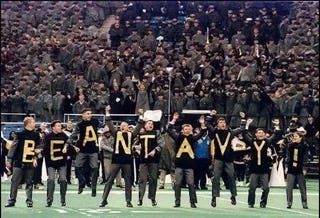
For the fall semester, these cadets and mids live behind “enemy lines,” taking classes, enduring the other academy’s quirks, and blending into a rival culture. Before rejoining their home side, they reveal taped messages on their backs; usually, lighthearted digs at their hosts. A personal favorite: in 1996, the cadets stood out of order and accidentally spelled “BEAN TAVY.” As a USNA grad, I must report this faithfully.
The Ball Run
Every year, the Army Marathon Team and the Naval Academy’s 13th Company run a football from their institutions to the host city. The tradition started more than four decades ago, and the distance changes depending on where the game is played. This year, Navy’s route sits around 30 miles from Annapolis, while Army’s run from West Point is a multi-day, 300-mile relay.


The balls arrive at the stadium before kickoff.
The (stolen) mascots
The rivalry also has a long history of mascot crime.
Navy’s mascot: Bill the Goat.
Army’s mascot: a mule.
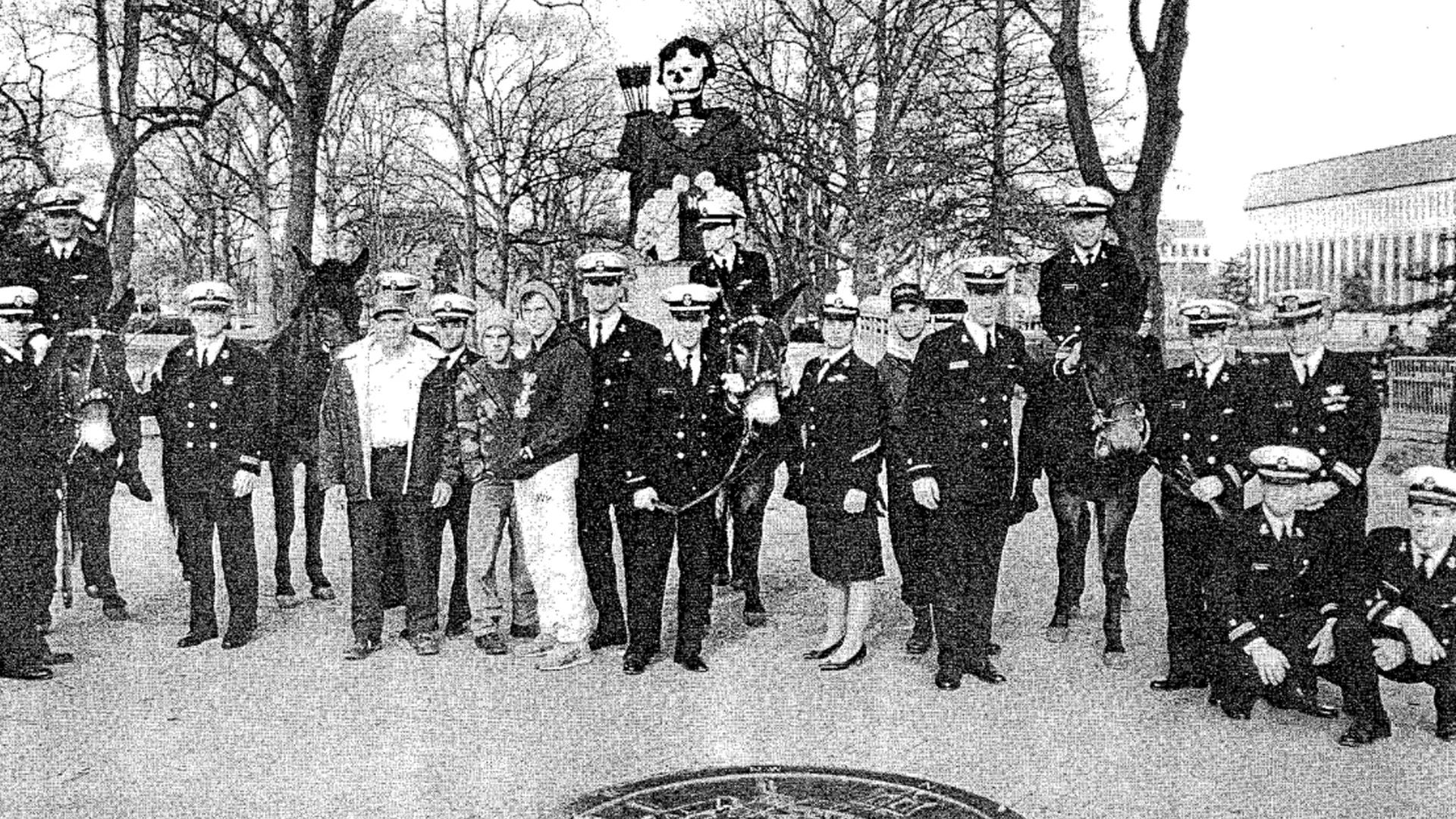
Cadets have stolen the goat (and sometimes failed). Mids have stolen the mules. There are stories about chloroform, barn raids, and incredibly elaborate cover stories.
Officially, both academies have banned mascot-napping. Unofficially, many grads have at least one “spirit mission” story that starts with, “So there I was…”
Preparing to Serve
There is a line people repeat about this rivalry:
The Army-Navy Game is the only game where every player on the field is willing to lay down their life for everyone in the stands.
Upon graduation, the cadets and midshipmen will commission as officers entrusted to lead Marines, Sailors, and Soldiers.


Here’s how Army’s seniors will serve:
Cooper Allan — Armor
Charlie Barnett — Infantry
Braden Bartosh — Field Artillery
Tanner Bivins — Infantry
Ned Brady — Infantry
Anderson Britton — Field Artillery
Dewayne Coleman — Engineers
Eric Ford — Air Defense Artillery
Kalib Fortner — Infantry
Liam Fortner — Infantry
Deshontez Gray — Field Artillery
Will Jeffcoat — Infantry
Casey Larkin — Field Artillery
Jack Latore — Infantry
Collin Matteson — Field Artillery
Hayden Reed — Armor
Sabastian Shannon — Logistics
Gavin Shields — Field Artillery
Noah Short — Field Artillery
Andon Thomas — Infantry
Jacob Tuioti — Logistics
Justin Weaver — Field Artillery
Jabril Williams — Air Defense Artillery
Here’s how Navy’s seniors will serve:
Liam Barbee — Marine Ground
Jaxson Campbell — Marine Air
Brandon Chatman — Marine Ground
Greysen Crawford — Marine Ground
Andrew Duhart — Marine Ground
Stephen Glenn — Surface Warfare
Kenny Hall — Surface Warfare
Eli Heidenreich — Marine Ground
Blake Horvath — Navy Pilot
Cody Howard — Marine Ground
Nate Kent — Naval Officer
Nate Kirkwood — Navy Pilot
Adam Klenk — Marine Ground
Chris LaFond — Surface Warfare
Jake Lusk — Surface Warfare
Kenny McShan — Navy Pilot
Tyler Narayan — Marine Ground
Luke Pirris — Navy Pilot
Ian Pourciau — Navy Pilot
Ben Purvis — Marine Air
Shane Reynolds — Marine Ground
Landon Robinson — Marine Ground
Harry Spencer — Marine Air
Dylan Spelios — Information Professional
Alex Tecza — Marine Ground
Adam Walker — Naval Flight Officer
Kendall Whiteside — Surface Warfare
Brady Wine — Surface Warfare
Sing Second
The rivalry is about respect, even in defeat. After every game, both teams sing their alma mater. The losing team sings first, with the winning team standing behind in support. Then they swap. “Sing Second” is a phrase used to express the winning spirit in the Army-Navy football game, where the winning team sings their alma mater second as a celebration of victory.


It’s one of the most emotional moments in sports. A reminder that, ultimately, we’re on the same team.
America.
So if you’ve never watched the Army-Navy game, this is your year. Kickoff is Dec. 13 at 3 PM ET. Grab some snacks, pick a side (Navy, obviously), and prepare for a game unlike any other.
Thanks for reading!
My cadet platoon leader and his roommate were involved in the 1995 goat napping (the one where one of the Navy goats nearly died). Supe nearly got kicked out...until a 4-star gave them a coin at the Army-Navy bonfire. *sad trombone noises for the Supe here--it was awesome to witness live*
Really nice overview. New subscriber, go Army.